Reducing scrap in ERW tube production
Scrap is a physical loss and a process signal. A single total-scrap number hides whether the plant is losing material during startup, steady production, cutoff, dimensional control, welding, surface handling, documentation, or customer containment.
Originally published in the ASTM A513 handbook (astma513.com), where specification-scoped A513 reference material remains.
Code the loss consistently, identify the first process stage where it became detectable, preserve the product/material/tooling/setup state, and confirm that corrective action reduces verified loss without weakening containment or quality controls.
Define the loss before improving it
Use more than one measure:
- Weight
- Length
- Pieces
- Material value
- Conversion value already added
- Lost production time
- Rework time
- Containment and sorting cost
- Customer or delivery impact
One measure can distort priority. A short length of high-value processed material may cost more than a larger weight of startup trim.
Use a controlled reason hierarchy
Start with broad categories that can be assigned reliably:
- Planned startup, shutdown, trim, and sample
- Material identity or incoming condition
- Entry and forming
- Fin and edge preparation
- Weld and scarf
- Cooling, sizing, reshape, and straightening
- Cutoff and length
- Surface and handling
- Dimensional or test nonconformance
- Documentation, traceability, or certification
- Maintenance or equipment event
- Other/unknown — with mandatory investigation above a defined threshold
| Field | Example |
|---|---|
| Loss stage | Weld and scarf |
| Observed symptom | Intermittent seam opening |
| Verified cause | Cause unconfirmed pending edge and process review |
| Containment | Coil and time boundary segregated |
| Final cause | Entered only after evidence confirms it |
A loss record with separate symptom and verified-cause fields (example)
Add a second field for the observed symptom and a third for verified cause. Do not use a cause code when only the symptom is known. This prevents the database from treating assumptions as history.
Find the first detectable stage
If finished tube is out of dimension, move upstream and determine where the dimension or its precursor first departs from the controlled progression. If a surface mark appears after sizing, identify whether the same clock-position evidence exists before sizing. If a seam split is discovered at cutoff, review edge condition, fin exit, welded condition, heat/pressure/speed, cooling, and fracture evidence.
The defect diagnostic guide on this site provides the full process-order workflow.
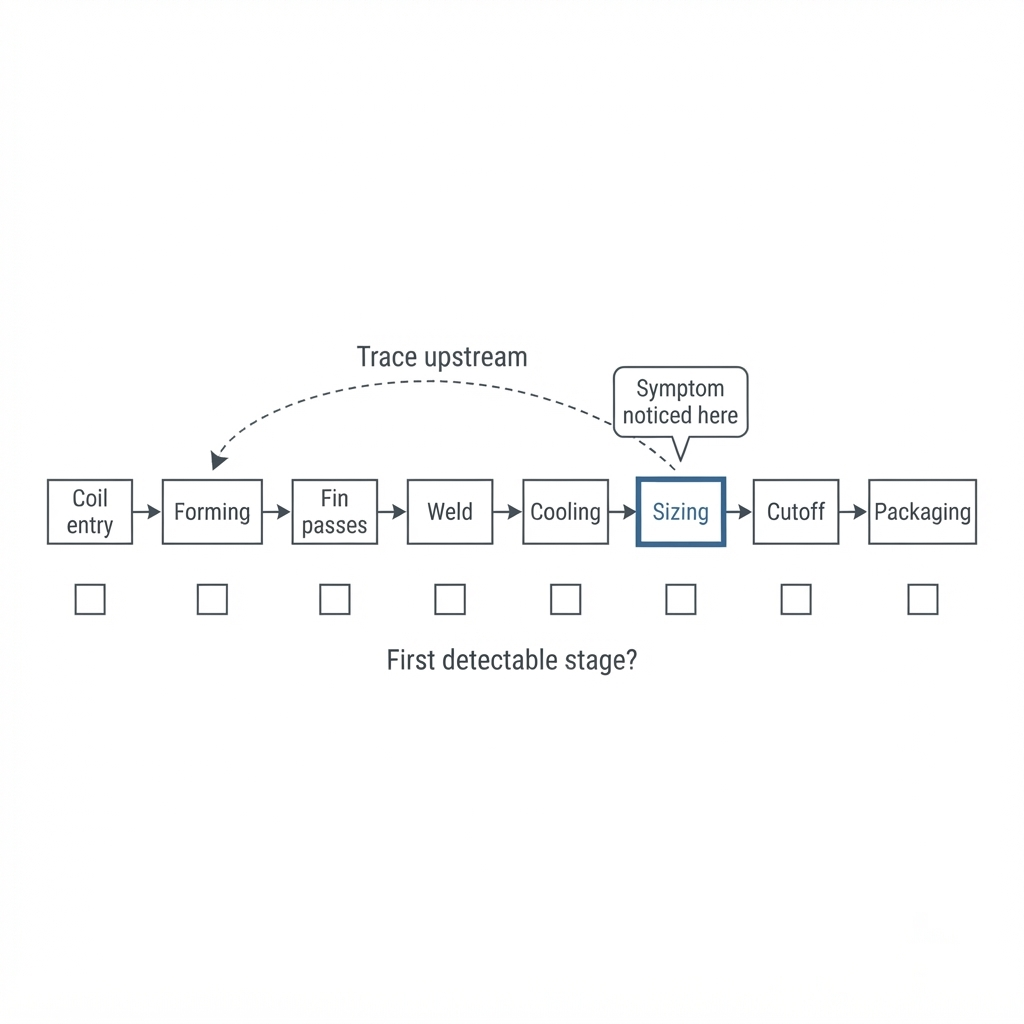
Place the first-detectable-stage question beside every production stage, then trace upstream from where the symptom was noticed.
Separate startup scrap from running scrap
Startup loss
Investigate:
- Material and tooling readiness
- Staging and changeover sequence
- Setup-chart accuracy
- Differences between target and stable-running actual
- Time spent searching, waiting, remeasuring, or correcting installation
- First-piece requirements and approval timing
- Whether a known-good setup corresponds to the current tooling geometry
Running loss
Investigate:
- Process drift
- Coil or material transition
- Tooling movement or wear
- Heat, speed, cooling, and load changes
- Measurement-system changes
- Alarms, maintenance, and operator interventions
- Time pattern or periodicity
Reducing startup scrap may require changeover and setup standardization. Reducing running scrap may require better detection, maintenance, material control, or process monitoring. Combining them in one rate hides the difference.
Preserve the run context
Every material loss event should link, at minimum, to:
- Run/job and product revision
- Material coil, heat, or lot
- Tooling set and regrind state
- Mill and setup revision
- Timestamp or production interval
- First detectable stage
- Symptom and quantity
- Disposition
- Containment
- Cause status
See the tube mill process control and digital setup records guide on this site for the complete model.
Prioritize recurring verified loss
A practical prioritization considers:
- Total financial impact
- Frequency
- Severity and customer risk
- Detectability
- Production constraint
- Recurrence across products or shifts
- Confidence in the cause
- Effort and risk of the proposed correction
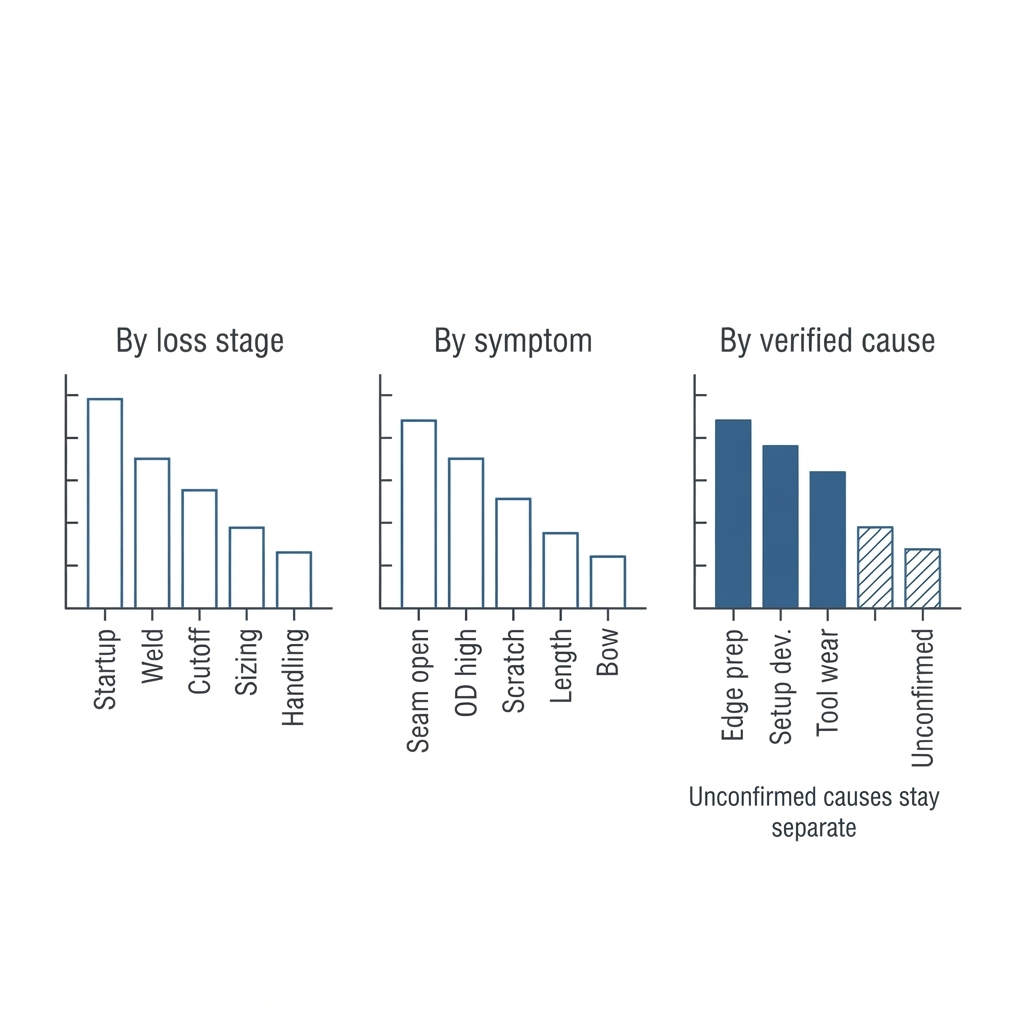
Fictional example: separate Paretos for stage, symptom, and verified cause. Unconfirmed causes stay separate.
Do not prioritize only the largest isolated event if a smaller recurring loss reflects a systemic condition.
Validate the corrective action
A corrective action is not validated because the next piece passes. Define before implementation:
- Expected mechanism
- Response measure
- Comparison baseline
- Run length or sample
- Affected product/material range
- Unintended effects to monitor
- Responsible reviewer
- Criteria for adopting, revising, or rejecting the change
Preserve both before and after states. If several variables change simultaneously, label the result as a package change rather than claiming that one element caused the improvement.
Protect quality and safety
Scrap reduction must not weaken:
- Containment
- First-piece approval
- Required destructive or nondestructive tests
- Traceability
- Calibration and measurement rules
- Guarding or lockout/tagout
- Qualified-person boundaries
- Customer approval requirements
Material saved by bypassing a quality gate is not scrap reduction.
Safety boundary: Tube-mill investigation and maintenance must follow site lockout/tagout, guarding, stored-energy, electrical, pinch-point, hot-work, lifting, and qualified-person procedures. Never inspect, measure, clean, thread, or adjust moving equipment unless an approved procedure explicitly permits the task and provides the required safeguarding.
Recommended dashboard
- Total loss by stage, symptom, and verified cause
- Startup versus running loss
- Weight, length, pieces, and financial impact
- Time to first good piece
- Loss by product, material lot, tooling revision, and setup revision
- Unknown-cause loss aging
- Recurrence after corrective action
- Cost of containment and rework
- Percentage of loss events with complete identity links
Dashboards should allow investigators to reach the underlying evidence rather than stopping at a chart.
Check whether a matching run is already on order at Tightsteel, our related digital warehouse for steel tube — or send the requirement and get a mill run scoped. Runs are planned mill production, not shelf stock; the producing mill and country of origin are disclosed to you before you’re bound to anything.
See what's on order → tightsteel.com/warehouse
Tightsteel is a related commercial venture. See /disclosures.